Catalogue Connection: 27809

  • Bizet’s Carmen Classic Historic recording review

    With little over 1200 seats the Opéra Comique is the perfect venue for Bizet’s Carmen which, truth be told has little comique in its tragic tale of the doomed love between a young Basque soldier and a Romani enchantress. But Bizet’s magnum opus, initially destined for a long life in its Parisian home turf, had legs, and walk it did right onto the major opera stages of the world, many much too large for it, when one considers how much more effective it is to enjoy Bizet’s masterpiece in a house where its original spoken dialogue can be heard and enjoyed.

    This superb 1928 studio recording flawlessly re-mastered and digitally restored by Andrew Rose of Pristine Audio and reissued by divine art (www.divine-art.com) in its HISTORIC SOUND (DDH27809) series is a sonically satisfying labor of love, especially when one considers that this Carmen dates back to the very early days of electric recordings. For practical reasons the recording deletes all spoken dialogue and the performance often cuts repeats, ostensibly to fit the musical numbers onto the side of an 78 RPM.

    The singers are beyond reproach, beginning with Raymonde Visconti, a star of the Opéra Comique in the pre-war years, in the title role. The possessor of a supple, lyric mezzo-soprano voice, Madame Visconti is enticing when on the prowl, gamine when it suits her, utterly expressive 100% of the time, a true singing actress who communicates with her voice by putting words first at all times. She “nails” both the Habanera and the Seguidilla, rivets one’s attention in the Lilas Pastias scene, hypnotizes in the Card scene, and is deeply moving in the final scene.

    Partnering her is the great Georges Thill, arguably the finest Don José of his generation. Thill has the ability to spin a seamless line in the Flower Song and then cap it with a stunning top B flat. A true lyric-dramatic singer Thill had the vocal reserves to match his Carmen dramatically and vocally in the confrontation in Act II, and in the final scene outside the bullring, and he could also sing like a boyish young fellow in his duet with Micaela, the enchanting Marthe Nespoulous.

    The Escamillo is the excellent Louis Guénot, an elegant singer with the bravado to pull all stops in the Toreador Song. The quartet of gypsies is made up of sopranos Andrée Vavon and Andrée Bernardet, and tenors Robert Roussel and Téo Mathyl, four top- of- the-line comprimarios with beaucoup humor and impeccable diction that they show to advantage in the act II quartet. The other supporting singers are, sad to say, not credited.

    The Orchestre Symphonique de Paris and the Chorus of the Opéra Comique are conducted by Elie Cohen, a house conductor who obviously knew his Bizet like the back of his hand, in a first class performance that lets one get a hint of how French opera ought to be sung.
    Rafael de Acha
  • Opera Magazine – Alan Blyth – 27809

    This pioneering Columbia recording of 1927, the first in electric rather than acoustic sound, offers us a welcome opportunity to experience the work as it was performed by an all-French company, and what a benefit that is! These artists know by nature than the text is as important as the music: all the principals play with the words in a way quite lost in an age of international casts, singers who have seldom if ever worked as an ensemble.

    Cohen was Columbia’s regular conductor of French opera at the time, and as in other works, completely enters into the spirit of the work in hand (oddly, the Flower Song was recorded separately and conducted by Philippe Gaubert). It may well be that the set was built around the great French tenor, Georges Thill, who sings the role in a way it has seldom been sung since. Words and music are perfectly wedded in his delivery. His voice is a strong lyric tenor bordering on the heroic. He is as adept at singing sweetly, as in the duet with Micaéla, and then truly forceful but never forced in the finales to Acts 3 and 4. The Flower Song is sung with weight and feeling, but it is a pity Thill sings the final B flat forte, rather than piano as Bizet wanted.

    Visconte at first seems a rather matter-of-fact Carmen: the first-act solos are not sufficiently characterised. But then this slightly casual reading seems deliberate: the Card Scene is sung accurately and with a real sense of foreboding and in the grand finale she defies José with magnificent courage and insouciance. Nespoulos was a popular soprano in Paris and elsewhere at the time: her Micaëla is sung in that clear, clean light, secure tone then favoured in this and so many soprano roles. Guénot is a personable and vivid Escamillo. The smaller parts are well taken, Zuniga and Morales apparently by members of the company.

    What we hear is a potted Carmen; all the essentials are there except the Act I finale, and no dialogue or recitative. The excellent transfers added to my pleasure in a set I had never encountered before. I recommend it as a second version in any reputable collection of French opera.

  • ClassicalNet – Gerald Fenech – 27809

    This classic recording deserves a return to the catalogue with a host of great French singers and the inimitable Elie Cohen at the helm; it truly takes its place amongst the great “Carmen’s” of all time.

    Although the set is definitely not complete as it clocks in at just over 110 minutes, it is hard to find a better version. The aura of Francophile experience permeates every single note and with singers such as the great Georges Thill and Raymonde Visconti, you cannot really go wrong. The orchestral playing truly comes alive in the fine remastering which is a credit to Pristine Audio’s achievements.

    Divine Art’s new Historic Sound series is fast becoming one of the major labels in this much sought after genre and this ‘Carmen’ deserves every success.

  • Musical Opinion – Judith Monk – 27809

    I put this CD on to play and then asked my husband to tell me when he thought it had been recorded. He said 1960s? The sound is exceptional when you consider what the original material must have been like. There are no hisses or scratches, just clear singing. Georges Thill, who sings Don José, was highly regarded in his day with a repertoire of more than 50 roles. He sang in all the major houses and even appeared in a film. The other singers were mostly stalwarts of Paris’ Opera-Comique but all here in fine voice too.

    The informative sleeve notes, written by Divine Art’s own Stephen Sutton, give an extensive background story of Bizet and Camen along with the libretto in both French and English and a lengthy explanation of how the remastering project was undertaken . It’s quite amazing to listen to something recorded nearly 80 years ago and find it as fresh as if it were pressed yesterday. I look forward to hearing more such high quality “blasts from the past” from Divine Art.

  • Classic Record Collector – Tully Potter – 27809

    It is an article of faith with vocal buffs that French singers were better in the good old days; but the prewar recordings of Carmen do not support that thesis. HMV and Columbia each made an Opéra-Comique and a Scala set and in general the Italians surpass the French vocally if not stylistically, especially when you get down to the chorus and the supporting cast.

    The reasons for buying this set are three-fold: Georges Thill, the excellent orchestra and the main conductor, Élie Cohen. Thill’s splendid 1927 Flower Song conducted by Gaubert is drafted in for economy, In his newly recorded scenes, Thill is magnificent as ever, singing with clean, focused tone and a fine line. The Carmen, Visconti, is a strong singer but short on subtlety and rhythmic variety – and a Carmen with no real rhythm is more tiresome than usual. Her Card Scene does not chill the blood. The Micaëla, like her opposite number in the HMV set, was a quite good Mélisande. She is appealing in the duet with José, where Thill is eloquent and two sides are rightly allotted (how could Columbia cut it to one side in the Scala set?), but she is inadequate in her aria. Guénot, like so many Escamillos, lacks the low notes for the part; he is uncertain of pitch and a little dull. Frasquita and Mercédès are nothing special, the secondary tenors are good. Moralés and Zuniga are not named.

    There is no dialogue and little cuts abound (this set comes in at 30 sides, to 34 for the French HMV Set; both Italian sets run to 38 but include Guiraud recitatives). The choral singing is nowhere near La Scala or Met standards of the time. However in Act 4 everyone miraculously raises their game. The toreador sings his little duet with Carmen quite nicely. Visconti’s well-focused voice comes into its own, Thill rises even more nobly to the occasion and the final scene is genuinely exciting. The recording quality is uneven, with fairly frequent distortion, but Andrew Rose has done battle with it meritoriously. Full marks for presentation, including a libretto and translation.

  • MusicWeb – Jonathan Woolf – 27809

    Sometimes a reissue comes along to make one think; well, have I heard this or not? The conductor is a recording regular, Elie Cohen, an experienced and practised executant on the rostrum. And then there is Thill the Magnificent. Surely one thinks to oneself one must know it, if not just for Thill. Oddly however this is a recording that has seemingly escaped the clutches of wholesale restorers. So the simple answer is no, I’ve not heard it before.

    Thinking of early Carmens reminds one that a light discographical truffling might be of interest. The earliest Carmen was the 1908 German language recording with Emmy Destinn, Karl Jorn, Minnie Nast and Hermann Bachmann and it’s has been restored by Marston. The next version was Parisian and made in 1912 with Marguerite Mérentié, Aline Vallandri, Marie Gantéri, Jeanne Billa-Azéma and Agustarello Affre (see review of Malibran’s transfer, though a more recommendable transfer is also on Marston). Then came an Italian Columbia set in 1920, followed by a recording directed in 1927 – the first electric – by Coppola with Perelli, Brothier, Trévi and Musy (on another Malibran CD). Then came this one with Cohen, followed sharply by a Sabajno-led Italian set in 1931 and another by Molajoli in 1933 with Pertile, Buades, Tellini and Franci.

    So we have never lacked for Carmens, and even in pre-First World War days there were two very recommendable cast recordings if one could afford it. This second electric recording has strong claims on the collector. Its star is Thill, who tends to eviscerate, in emotive terms, his fellow cast members. Thill’s versatility encompassed the ringing and declamatory as well as the gently caressing – and all stops in between. His is an impersonation of the fullest richness and the close attention to consonants and vowel production of a native French speaker brings its own inestimable colouristic advantages. The text is ringingly alive when Thill is on hand. He is elegant and he is charming, he is suave and commanding.

    His Carmen is Raymonde Visconti, seven years older than Thill. She’s perfectly acceptable but only really comes alive as the opera reaches its close. The earlier scenes find her just a touch metrical and overly straightforward. When she and Thill share their Seguidilla and duet in the First Act one finds too much of a buffer between his kaleidoscopic humanity and her studiedly neutral competence. Michaëla is Marthe Nespoulous, a soprano of considerable girlish refinement. Hers is a typically French voice and I find it very persuasive. It’s well supported, unaffected and has theatrical presence, though I wondered momentarily as to its carrying power on stage. I also liked the Escamillo of Louis Guénot who also, in his own very different, blustery way – has an effective stage persona that manages to transcend the grooves. It wouldn’t do to suggest that he has the most imperishable of voices but he’s enjoyable and gives good value. So I think it would be wrong to limit this to a one-man set. True, Thill is by some considerable distance the most marvellous singer here but there are at least two other performances of some stature.

    The transfers sound very well. Andrew Rose seems to have done something similar to his restoration work on E.J. Moeran’s symphony; he seems to have strengthened string tone, maybe by strengthening the bass line – though without access to the original set it’s difficult for me to make any kind of meaningful comparison. He notes the original recording was “thin” and this was “corrected by reference to a modern recording.” The results, on a stand-alone basis, sound very acceptable.

    The recording obviously is not complete – there are no recitatives and no dialogue – but this was an almost invariable corollary of recording at the time. We do have texts, a plot summary and artist biographies. So all in all that early Carmen discography is taking on an increasingly healthy look on CD, greatly helped by this most worthwhile addition to the catalogue.

  • Radio Belge – Michel Tibbaut – 27809

    On the appearance of electrical recording in 1925, His Master’s Voice and Columbia in France competed to offer more-or-les complete recordings of various operas, including among the first to be issued by Columbia, Carmen and Pelleas et Mélisande (1928), Manon, (1928/9), L’Heure Espagnole (1929), Werther (1931), Mignon (1932), Louise and Otello (1935).. Moreover, Columbia had the happy advantage of engaging the French tenor George Thill (1897-1984) for four of them – Carmen, Werher, Louise and Otello. This very neat re-issue concerns the most famous – Carmen. We must establish that notwithstanding the announcement on the original 78s, it is not a complete version, as it excludes the spoken dialogue and the sung recitatives, the latter written by Ernest Guiraud, moreover some items were shortened, to cater for the limited duration of the original discs, at about 4 minutes per side.

    Originally issued as Columbia Masterworks album no. 87, this pioneering recording of Carmen thus had the advantage of counting among its interpreters, in the role of Don José, the impeccable Georges Thill, considered by many music lovers to be the best French tenor of the twentieth century. Although already well known after leaving the Paris Academy where he was the pupil of Ernest Dupré and the celebrated bass André Gresse, this admirable musician himself only regarded his career as really beginning having followed the career of the legendary Fernando de Lucia in Naples, which revealed to him a voice alloying all the richness of bel canto with French style. Truly, his career can be said to have begun precisely in the role of Don José at the Opéra Comique on May 15, 1918. He was the heroic and lyric tenor par exellence, who with his warm, clear voice, was seldom equalled in evenness, robustness and vitality.

    This CD transfer, carried out by Stephen Sutton of Divine Art and Andrew Rose of Pristine Audio, is of such naturalness and quality that the voice of Georges Thill appears remarkably clear, with great presence, with all its élan, its inflection and not least its nuances; the tenor is one of few to give all of his dignity in the emotionally difficult role of José. It should be recognised that his colleagues are not all in the same league: Raymonde Visconti is quite a pale Carmen who shows little of her character’s full personality. Marthe Nespoulous manages to move us, despite her character Micaëla’s silliness thanks to her youthful freshness and her fine sensitivity, in spite of a sometimes wavering intonation. Louis Guénot gives us an honourable Escamillo though he can be a little stiff – but this is really unavoidable in this role. The secondary roles are honestly played, even if Robert Roussel as Dancaïro has neither the accuracy of intonation or pleasantness of timbre required. As for conductor Elie Cohen, he directs with competence and dynamism, but one has to remember that the recording techniques of the age favoured the soloists very much more than the chorus and orchestra.

    In short, a very welcome historical re-issue which is characterised especially by the incomparable presence of Georges Thill as Don José.

  • International Record Review – John T. Hughes – 27809

    Possibly the most famous, or infamous, operatic lovers from Spain are Carmen and José. In Merimeé’s book, José was nastier than in Bizet’s opera. The recording of Carmen to hand is the Columbia abridgement of 1928, issued by the worthy little company Divine Art, whose booklet even provides words and translations. Between 1928 and 1933, four ‘complete’ recordings of Carmen were issued, two in French and two in Italian, with this Columbia set the earliest, though still preceded by three more from earlier decades. Its leading quartet consists of Raymonde Visconti, Georges Thill, Marthe Nespoulous and Louis Guénot. This last sings Escamilo but also contributes the few lines of Moralès and Zuniga, unlisted. He has an open sound, not orotund but not wooffy, and manages to sing both top and bottom notes in ‘Votre Toast’, which not all who take Escamillo can do. Nespoulous is a bright-voiced Micaëla, neat and accurate. To José, Thill brings stylish vocalising (a pity the B Flat in the Flower Song is not sung quietly) and without ranting and raving is intense in the final scene. If Thill does not rant, Visconti is not a Carmen who chews the scenery. In the booklet she is listed as a mezzo, and sounds like one, but apparently Manon and Mimi were in her repertoire. Some will find her too placid. Divine Art’s transfer is very clear, with no ‘overcooking’ of the original.

  • Keene Sentinel – Frank Behrens – 27809

    Very often, a vintage recording affords only historical interest; sometimes there is great artistic merit also involved. The 1928 recording of Georges Bizet’s “Carmen,” now on the Divine Art label (27809), has a little of each.

    First of all, it is by no means complete. With a running time of less than two hours, this production omits all of the dialogue, leaving only the musical selections, many of which are abridged to fit onto a side of a 78 rpm disc.

    Then, too, the singers, with one exception, merely sing their roles with very little attempt at characterization. The Carmen of Raymonde Visconti is small-voiced and lyrical where it should be dramatic. The Escamillo of Louis Guenot is a bit more dramatic but still a dull potato. There is not much any soprano can do with Michaela, nor can Marthe Nespoulos on this recording. The supporting roles are in no way exceptional.

    However, it is the Don Jose of the nearly legendary tenor George Thill that is the major attraction of this set. It is so good to hear that role sung by a Frenchman for starters, and one with that Thill thrill for good measure. He is what gives value to this set and why I can recommend it for those who are interested in this wonderful tenor.

  • Bizet: Carmen

    Bizet: Carmen

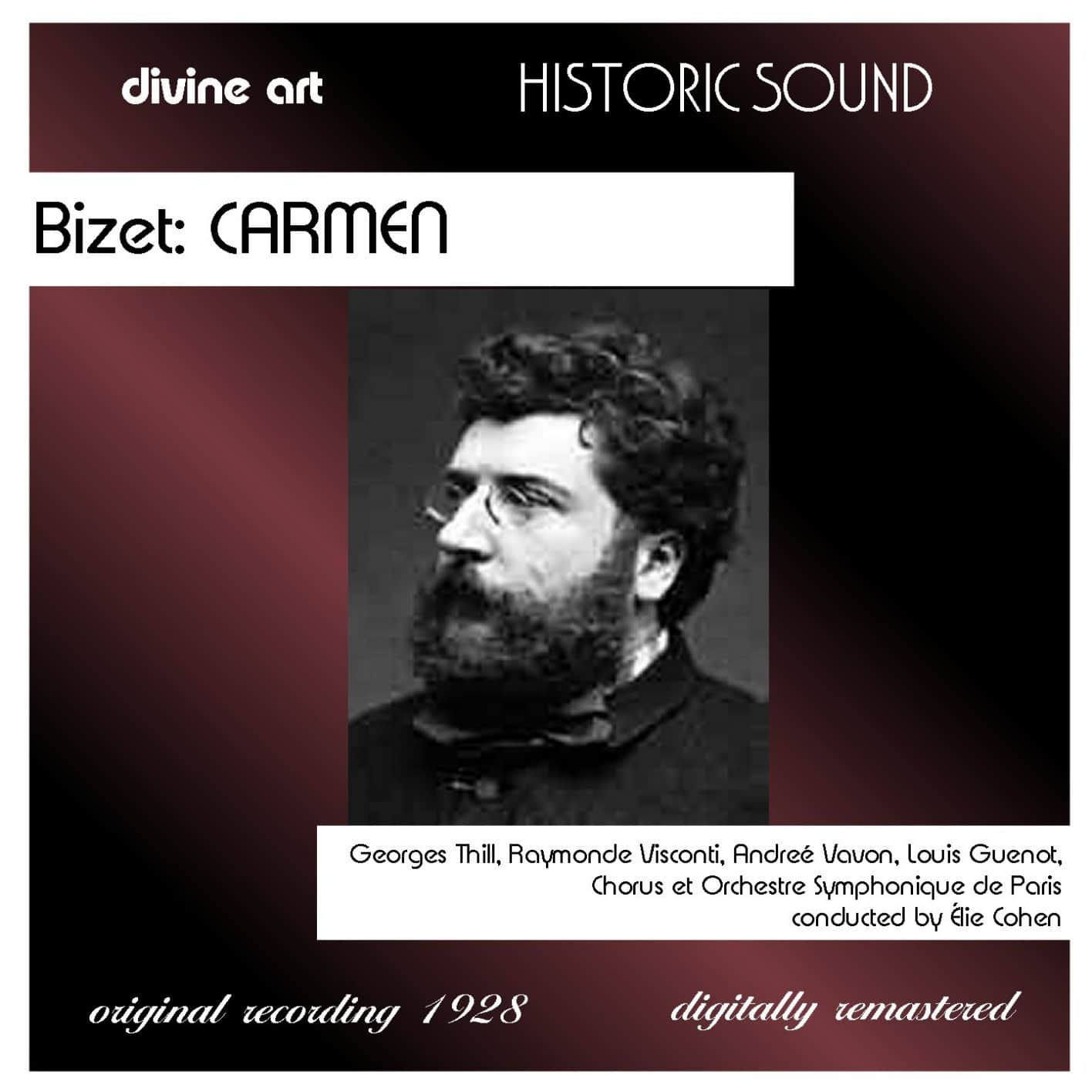
    Raymonde Visconti, Georges Thill, Louis Guénot, Andreé Vavon, Andreé Bernadet, Choeur et Orchestre Symphonique de Paris, conducted by Elie Cohen*

    This classic recording of the world’s most popular opera, made in and around 1928, has previously only had very limited exposure on LP or CD. While advertised and labelled as being by the Paris Symphony, the forces are actually those of the Opéra-Comique. In Georges Thill, playing Don José, we have the greatest French tenor of the century, and overall this is a memorable performance, as ever restored with great skill by Pristine Audio.

    DRAMATIS PERSONAE:

    Carmen: Raymonde Visconti (mezzo-soprano)
    Don José: Georges Thill (tenor)
    Micaëla: Marthe Nespoulpous (soprano)
    Escamillo: Louis Guénot (baritone)
    Frasquita: Andreé Vavon (soprano)
    Mercédès: Andreé Bernadet (soprano)
    Dancaïro: Robert Roussel (tenor)
    Remendado: Téo Mathyl (tenor)

    * The Flower Song (CD1, track 13) recorded in 1927 and conducted by Philippe Gaubert.