Catalogue Connection: 27810

  • ClassicalNet – Gerald Fenech – 27810

    This long lost recording made for what was then the Gramophone Company, Milan in 1920 is a window on the past that has vanished for quite some time. The crop of quality singers and the much underrated Carlo Sabajno combine together to provide a truly world class performance on all counts although the opera sung in Italian may not be to all tastes. (*)

    Romagnoli is a tenor of true stature and he sings his parts with consummate ease although the restricted sound obviously limits our appreciation of his greatness. The same goes for the almost completely unknown Gemma Bosini who is also a fine exponent of Marguerite. Fernando Autori’s “Mefistofele” reminds me of the late Norman Treigle’s unmatched performance on EMI which remains my favourite recording of the opera. The minor roles are similarly well taken.

    We are indebted to Stephen Sutton who has generously decided to make this recording available with a stunning remastering from his private collection of 78 rpm discs. The notes also include some fascinating biographical sketches of the singers involved and are also very detailed on the historical aspects of this seminal recording along with some fascinating details on the matrixes and issue numbers. This is an essential historical document which is a must for all fans of opera in all guises.

  • Musical Opinion – Robert Matthew-Walker – 27810

    There are not many complete opera recordings that go back almost 90 years, but this is certainly one of them, and we must be particularly grateful for Divine Art for bringing this first-ever recording of Faust once more to the public, especially in such an excellent transfer of Italian acoustic 78s as has been accomplished by the engineer Andrew Rose of Pristine Audio with absolutely minimal surface noise. Thus, we can – all due regard being made for the age of the recording – appreciate this set as a genuine performance, not merely as some kind of historic relic, and with this in mind we enter a world of singing which has virtually disappeared from the face of the earth.

    Faust was first heard in 1859, around the time that Napoleone Limonta, who sings Wagner in this recording, was born. Limonta took part in the premiere of Otello in 1887 and in Toscanini’s Die Meistersinger in 1898. He must have been around 60 when this recording was made, and it is as Stephen Sutton rightly says in his excellent notes, a very creditable achievement. Giuliano Romagnoli takes the title role very well indeed, and all the other principals are really outstanding, giving the distinct impression of a genuine company production. Mention must be made of Gemma Bosini (Margeurite) who is first-class; she was married to Mariano Stabile. Carlo Sabajno will be known to older 78rpm collectors, for he conducted many operatic recordings, and was a really fine musician. We ought not to forget that Toscanini was principal conductor of La Scala at the time this set was made, and without trying to read too much into that fact, the quality of this world-class opera company shines through these old discs with an excellence and unfailing deep musicianship that justifies this reissue in artistic grounds alone.

    There is a genuine sense of atmosphere here which makes this a fascinating and, in its way, important set of CDs.

  • International Record Review – John T. Hughes – 27810

    It is with a 1920 recording of a French opera set in Germany and sung in Italian translation that [this roundup of opera and vocal discs] begins. The Gramophone Company’s branch in Milan assembled the cast, the chorus and orchestra of La Scala and conductor Carlo Sabajno to record Gounod’s Faust in June of that year, the result being issued on 20 discs. Divine Art, which has reissued the Visconti/Thill Carmen from some years later (27809), releases the first CD transfer of this little-known recording. Although a relatively small organization, Divine Art has gone to the trouble of printing the Italian libretto in the booklet, for which collectors should be grateful.

    Faust is the tenor Giuliano Romagnoli, who is joined by the more famous Gemma Bosini (later to become the wife of Mariano Stabile), Fernando Autori and Adolfo Pacini. Romganoli’s voice is not a first-class instrument but it is well schooled. A slight throatiness seems evident on lower notes but is not worrisome. He provides some thoughtful phrasing in Faust’s scenes with Marguerite. It is in those, such as ‘Il se fait tard’, that Bosini is at her best. Her Jewel Song sparkles less than the gems presumably did, but in the more intense or serious scenes, like that duet or the meeting with Mephistopheles in the church, she makes a better impression. Her voice does take on an edge under pressure. Pacini’s voice is more powerful in its top half than lower. Gilda Timitz’s thin, white tones do nothing for Seibel, or me, but Nelda Garrone makes something of Marthe.

    That leaves Autori as Mephistopheles; a vital , vivid, vibrant interpretation, as heard in ‘Le veau d’or’. His voice is a true bass yet rings on high. He brings the character to life without excess: one of the best. Andrew Rose’s transfers are well done. English and French librettos are included as a downloadable PDF file.

  • MusicWeb – Göran Forsling – 27810

    Recorded acoustically in 1920 and sung in Italian by Italian singers this issue could easily be passed over as of limited interest – possibly only for historical freaks. I am one of those – I wouldn’t have opted for the set otherwise – but even I have to admit that it was a very pleasant surprise. One of the first notes I scribbled down on my review pad was ‘Superb sound!!’

    I must be joking, mustn’t I? Actually no. Readers only familiar with state-of-the-art digital stereo recordings will probably frown at the sound here and quickly turn it off, but anyone who has ever heard the feeble, scrawny sound of the orchestra, the thin, undernourished tone of the singers and the appetizing sound of someone frying bacon in a nearby kitchen will sit up and reach for the booklet: Is it really 1920?

    I have to qualify my verdict. The orchestra can never be mistaken for a modern one, the dynamics are limited but instrumental details are well caught, drums and trumpets in the opening of act II lifelike, the chorus has great impact, the singers leap out of the speakers with surprising realism, even in the quartet (CD 2 tr. 2-3) the voices are well separated, and the cook has closed the kitchen door. Andrew Rose has worked wonders with the original shellacs that obviously were of exceptional quality for their time in the first place. With very little adaptability it should be possible to enjoy the performance, once one has adjusted to the limitations.

    That it is sung in Italian may seem as a drawback but one should bear in mind that the practice to perform operas in the original language is a rather late invention. This set, issued on twenty 12” discs, was no doubt intended for the Italian market. Italian is of course an eminently singable language and Italians singing in the vernacular give a stamp of authenticity. This is what it sounded like at La Scala around 1920.

    Probably the cuts in the score were also those applied at performances eighty years ago. For so long an opera on shellacs it is fairly little truncated: the ballet scene is gone – no great loss – and there are minor cuts in the waltz, love duet, soldiers’ chorus and three in the final scene. The act IV prelude and Marguerite’s recitative is omitted.

    Carlo Sabajno – who wasn’t named on the original labels – was a splendid conductor who recorded a considerable number of complete operas in the 1920s and 1930s. He secures fine playing and singing from the La Scala forces and paces the music as well as any of his competitors.

    About the solo singing there may be some reservations, but also these are relatively marginal. The little known Giuliano Romagnoli in the title role sacrifices Gallic elegance for Italian passion in the title role but he is no mean singer. His legato isn’t always the best, he tends to over-emphasize in the Di Stefano manner and his high C in the cavatina is ugly but he manages a fine scaling down on the final note and his impassioned singing in the duet Il se fait tard is truly engaging. His Marguerite, Gemma Bosini, who besides this Faust also has a complete Bohème to her credit, has an agreeable voice and more sense of style. She sings a fine Jewel song and in the duet she is heartrendingly vulnerable.

    The star of the performance is however Fernando Autori as Mephistopheles. He has a magnificent black-tinted bass and his is a truly riveting reading of the role, expressive and dynamic. His rondo in act II (CD 1 tr. 11) is the tour de force it should be and altogether his is one of the most impressive devils on any recording.

    In the minor roles veteran Napoleone Limonta is a rather wooden Wagner while Adolfo Pacini has a splendid voice but totally lacks light and shade in Valentin’s Avant de quitter ces lieux. He makes amends however on his return in act IV and his death scene is deeply involved. Nelda Garrone is a rather squally Marta but Gilda Timitz is an excellent Siebel and her/his flower song (CD 1 tr. 17) is one of the highlights of the whole performance.

    André Cluytens’ stereo remake of Faust from 1959 with los Angeles, Gedda and Christoff (now in EMI’s GROC series) is still the recommendable ‘modern’ recording and there are several good alternatives, but readers with some historical interest will find a lot to admire on this almost 90-year-old surprisingly listenable version – and Fernando Autori’s Mephistopheles must be heard.
  • Midwest Record – Chris Spector – 27810

    Is this too cool or what? A 1920 recording of “Faust”, recorded at La Scala with a cast that has names that sound like something out of a Marx Brothers movie making fun of classical music. Well, call me Emmanuel Ravelli! A double disc set taking the whole performance in, released probably for the first time on CD. Any self respecting opera fans will want to grab a copy of this just for the bragging rights. Then, after while, they’ll probably get into the cool job of sonic restoration as well. Quite the dandy find for the real hard core opera fan.

  • New Classics – John Pitt – 27810

    Charles Gounod’s five act opera Faust was written to a French libretto by Jules Barbier and Michel Carré, based on Carré’s play Faust et Marguerite which itself was loosely based on the first part of Goethe’s Faust. The opera debuted at the Théâtre Lyrique in Paris in 1859 but was not well-received. Recitatives were added to replace the original spoken dialogue before the opera was successfully revived in Paris in 1862, after which it became the most frequently performed opera at the Théâtre Impérial de l’Opéra. It also went on to become a staple of the international repertory, despite a full production requiring a large chorus and elaborate sets. Faust was first performed in Italy at La Scala, Milan, in 1862, with an Italian libretto by Achille De Lauzières. The recorded version here follows this edition closely, omitting the ballet scene and with minor cuts in the Waltz, Love Duet and Soldiers’ Chorus as well as in the final scene.

    The recording was made by the Gramophone Company’s Milan office over a two-week period in June, 1920, and was originally issued on twenty 12” discs. Though recorded acoustically, these discs were in mint condition and careful restoration has been carried out to avoid digital distortion, providing remarkably good overall sound quality that allows the excellent performances to shine through. The booklet with this double CD contains the Italian libretto as well as a synopsis of each act and biographical details of the main performers, who include Giuliano Romagnoli (Faust), Gemma Bosini (Margherita), Fernando Autori (Mefistofele), Gilda Timitz (Siebel), Napoleone Limonta (Wagner), Adolfo Pacini (Valentino) and Nelda Garrone (Marta). The Chorus and Orchestra of La Scala is conducted by Carlo Sabajno. This is the first time that this important historical recording has appeared on CD and it’s a memorable version of one of the most popular, tuneful and sophisticated operas ever composed.

  • Fanfare – James Miller – 27810

    As you may have inferred from the names of the characters, this is an Italian-language recording of Faust. Made using the acoustic process back in 1920, it wasn’t even the first recording of the opera, having been preceded by a 1908 German recording conducted by Bruno Seidler-Winckler. It wasn’t even the second recording of the opera, since Pathé issued a 1912 French recording led by Francois Ruhlmann. It was followed in 1930 by an English-language Faust , led by Sir Thomas Beecham. Four recordings of Faust in four different languages at a time when a complete opera recording could cost some folks a week’s salary – if that doesn’t testify to the opera’s former popularity, I don’t know what does. For most people, I suspect, the first “real” recording was the 1931 French version led by Henri B?sser, which holds up well even today. The premiere of Faust took place in 1859. Note that all the recordings above were done closer to that time than to the present.

    Unfortunately, I can’t say that this 1920 performance’s closer proximity to Gounod’s day proves anything as far as vocal style and tradition means. Like all early Fausts , it’s not really complete; I would call it the standard cut edition you might have heard in a theater any time during the last century, with the addition of some short excisions that were probably due to limitations in the length of the 78 sides. I wasn’t expecting to hear Margarita’s “Spinning Song” or Siebel’s aria that follows it, so their omission was no surprise; and I assumed that the Walpurgis Nacht would be missing—no surprise there, either. Smaller cuts include the second verse of “The King of Thule,” a slightly curtailed love scene, and the Prelude to act IV, which actually starts with the entrance of Faust and Mefistofele (I might as well use the Italian names). There are also very brief cuts in the Kermesse, the Soldiers’ Chorus, the final trio, and the closing scene. Obviously, there are alterations in the melodic line to accommodate the Italian text and, just as obviously, Gounod’s orchestration had to be revised to deal with the peculiarities of the acoustic process (for example, there’s no organ in the Church Scene). I was surprised at how easily I adjusted to this. The chorus had to be diminished in size because you can only fit so many folks under a recording horn. Yet, one even gets used to that. Divine Art seems to have done its job well.

    You probably have never heard of any of these singers. The only one I could find out anything about as the Mefistofele, Fernando Autori, who, despite his presence on this recording, didn’t actually sing at La Scala until 1924. He was primarily known for buffo roles and had enough of a career to sing elsewhere in Europe. The annotator may have had better sources, but even he draws some blanks about such things as birth years when dealing with the rest of the cast, and apparently knows only a little more than I do, which is nothing. Most of the singers have rapid little vibratos, but their voices are not unattractive, just not particularly striking. Autori has a dark voice and fairly smooth delivery; assuming he had enough volume, I don’t doubt that he would have been a passable Mefistofele, since he isn’t crude and heavy. As Margarita, Gemma Bosini’s voice often takes on a charming, girlish quality that suggests her character’s innocence. It’s not a ravishing instrument, but a serviceable one, and not particularly shrill. Giuliano Romagnoli comes across sounding like a lyric tenor, so I assume he was (the acoustic process tended to cut everyone down to size). His performance of the act II cavatina is the right weight but overheated, and sometimes he injects too much “passion” into his love scene. He doesn’t ruin the performance, but that’s about all. Was it a money problem that caused so many early 78s to be made with second-line casts? In 1920, there were singers in Italy who could have given us a Faust for the ages. This one exercises its fascination because of its age, not its quality. There is an Italian libretto and such information about the singers as the annotator could scrape up.

    ***Mr Miller later acknowledged the availability of English and French librettos on the CD

  • Art Times – Frank Behrens – 27810

    Edith Wharton’s “The Age of Innocence” opens at a New York opera house in which Gounod’s “Faust” is being performed—in Italian. Wharton explains that the language change was because “an unalterable and unquestionable law of the musical world required that the German text of French opera sung by Swedish artists should be translated into Italian for the clearer understanding of English-speaking audiences.”

    Actually, most European opera houses once performed all operas in the language of that country. It was not until the airplane made it possible for artists to hop from city to city, having learned their roles in the language the composer intended. All this to report on a 1920 recording of “Faust “ in Italian that has been rescued from oblivion and put into a 2-CD set on the Divine Art label as part of their Historic Sound series.

    Of course, it is abridged (the Walpurgis Night sequence is entirely omitted) and the sound is very good acoustic (pre-electric). Granted that, its being sung in Italian gives it a certain historic quality. The cast is quite good, especially the Mephistopheles of Fernando Autori, who does not ham things up the way some Slavic bassos have done in more recent times.

    The others in the cast are Giuliano Romagnoli (Faust), Gemma Bosini (Margherita), and Adolfo Pacini (Valentino). Carlo Sabajno conducts the Chorus and Orchestra of La Scala, Milan in this 143-minute version that can stand on its own vocally against some of the more recent French-language versions (featuring several Italian singers in much need of French pronunciation lessons).

    Much of the text sticks closely to the French original, and linguists will be interested in the departures that change some of the meaning of crucial passages. I was delighted to find the entire Italian text (but no English translation) included in the very informative booklet. Those who can bring up the PDF file on the second disc can follow the French-English-Italian text on their screens or print it out for easier reference.

    “Faust” in Italian? Why not?

  • Gounod: FAUST

    Gounod: FAUST

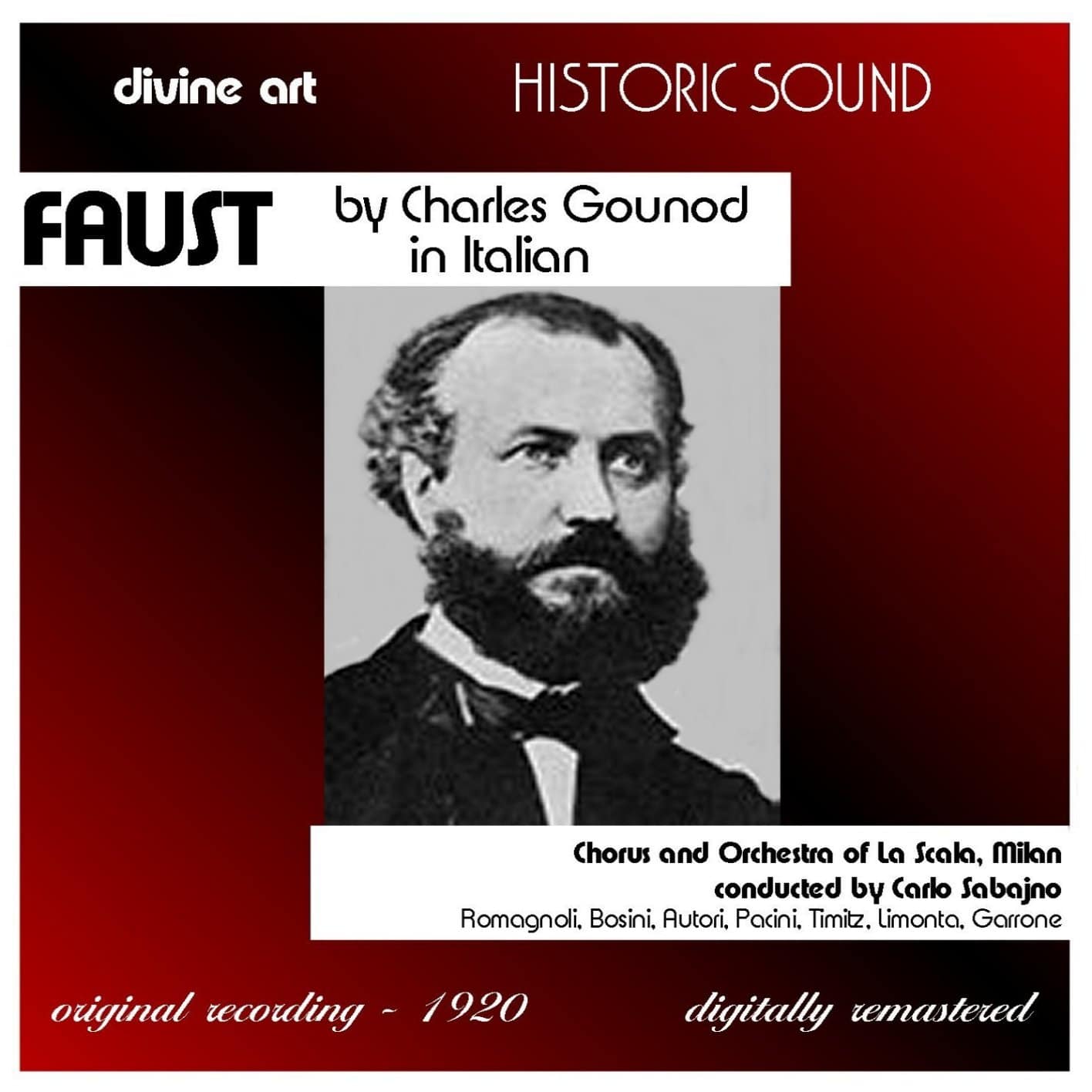
    Our most ambitious vintage recording yet, this version of Faust (in Italian) was recorded by La Scala Milan, under the baton of Carlo Sabajno, in 1920 using the acoustic recording process. Magnificently restored and re-mastered by Andrew Rose of Pristine Audio, this is THE classic opera performance and not to be missed.

    The CD booklet contains full libretto in Italian, and the English, French and Italian librettos are provided in a PDF file on the CD which can be printed from any PC.

    The digital album includes the main booklet and the triple libretto is available in PDF format on request.