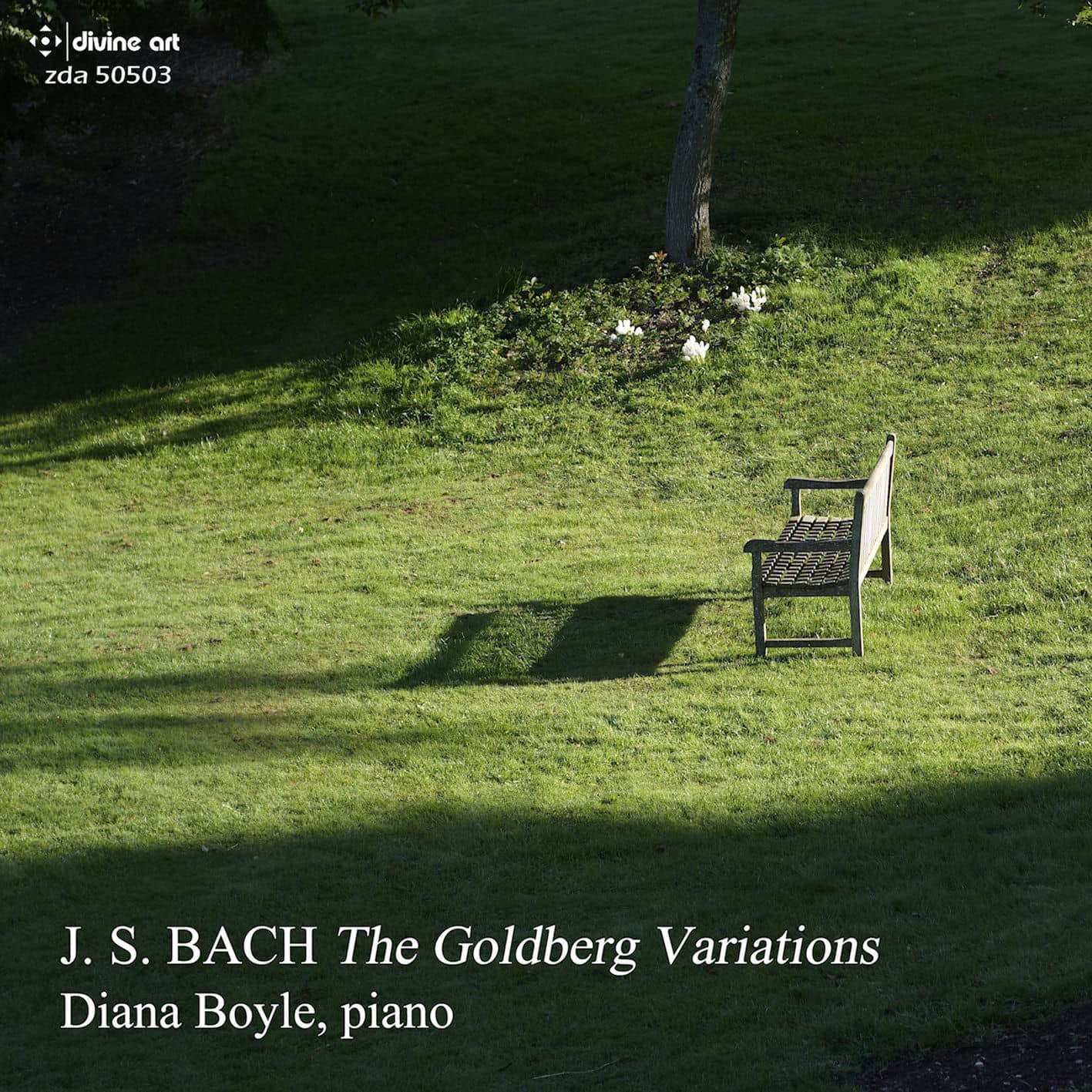
British pianist Diana Boyle is not well known in Italy but is considered one of the best pianists of old Albion. Her discography reveals that her activity is established definitely around the classical period given that her interpretative focus is on Bach, Mozart, Beethoven and Brahms – a line drawn from the base of tonal language, passing through the development of the Vienna School until reaching the composer who having drawn fully on Classicism closes the door of Romanticism to open the way for modernity – a pfor the artist who lives in seclusion in southern Portugal who conducts a coherent search, reflecting and meditating, in order to establish her artistic and aural approach. And so here the two recordings we are considering represent the alpha and omega of that narrative thread of repertoire, Bach’s Goldberg Variations and a miscellanea of Brahms’s piano works.
[notes on Brahms removed]
The Bach recording cannot be counted among the increasing number of ‘scrupulously philological’ (“authentic period”) recordings not only for the use of a modern piano. Boyle mentions three points which underscored her point of view to this work: first, as is her habit, she avoided listening to any other recording of the work while studying it, even that of her inspiration, Glenn Gould; second she did not study the work in chronological order but from the Canons, then to the slower, more lyrical sections; third, that in order to understand the work fully she also needed fully to understand the even greater masterpiece of Bach, the Art of Fugue, which she considers the most indispensable work in his output. Now, given these three aspects of her view, we can understand fully her particular interpretation. Compared with the other recordings from the historical ones of Turek and Gould, her result is not typical because her interpretation and the fluency of her musical speech is highly influenced by a very careful, pronounced way of phrasing. For Diana Boyle, the Goldbergs are not a set of separate segments, but a continuous narrative line, and to emphasise this ‘speech’ pattern, uses much rubato (contrary to the likes of the ‘purists’) in a way reflecting the thinking and performance style of the Vienna School and Romantics. So the fragmentary Variations become a continuous flow within which the alternation of the variations appear like scenes on which to pin the phrases: a legato, a rubato.. which again prepare the listener for the format of the later and great work, the Art of Fugue.
Boyle can stretch the tempo changes so that ‘slow’ becomes slower, reflective and meditative; allegro is accentuated by use of pedals; there is a feeling of dance that reminds us of rococo style, and unexpected dynamic changes (ff to pp) which especially emphasise the passage from tonic to dominant, have almost a theatrical connotation and definitely display a Romantic approach, as examples variation 26 and Quodlibet which almost takes the aspect of a Ländler.