Composer: Robin Stevens

  • Robin Stevens: A Questing Soul

    Robin Stevens: A Questing Soul

    American Record Guide 2025 Critic’s Choice

    Robin Stevens’ A Questing Soul, his fifth album with Divine Art, offers a compelling portrait of a composer whose work has evolved over nearly three decades. This collection spans a broad stylistic spectrum, charting Stevens’ progression from the lush Late Romanticism of his early works to the more dissonant and experimental idioms of his later compositions. Throughout, Stevens balances technical innovation with an underlying sense of lyricism, humour, and tonal clarity, making this album a rich listening experience for those who appreciate the depth and variety of contemporary chamber music.

    The two most substantial works on the album—Fantasy Sonata and Sonata Tempesta—were composed during Stevens’ late twenties and represent key milestones in his early output. The Fantasy Sonata, written for violinist Christine Townsend and pianist Stephen Robbings, presents an intensely focused sound world built around the octatonic scale. Its single-movement structure moves from a soulful, lamenting introduction to more turbulent, faster sections, culminating in a joyfully intense peroration. Sonata Tempesta, in contrast, is a large-scale, four-movement work whose expansive form allows Stevens to weave together moments of lyrical beauty and stormy intensity. Both pieces showcase Stevens’ ability to combine complexity and accessibility, creating compositions that are intellectually stimulating yet emotionally resonant.

    The album also includes a number of shorter works, or “miniatures,” which offer Stevens the opportunity to explore new compositional ideas on a smaller scale. Pieces like Stratospheric! for solo violin and Toccata for solo piano demonstrate his flair for virtuosity and dynamic contrasts, while others, such as Cri de Coeur, evoke more contemplative, intimate soundscapes. These miniatures are fascinating in their own right, offering a glimpse into the composer’s more experimental tendencies.

    One of the album’s more unusual works, Scherzo in Blue, brings jazz influences into Stevens’ instrumental music—a rarity in his oeuvre. The piece is infused with “blue notes” and jazzy piano chords, creating a playful yet sophisticated contrast to the more classical structures found elsewhere on the album.

    The title track, A Questing Soul, reflects the essence of the album: a compact tone poem for solo piano that alternates between dreamy lyricism and muscular, assertive themes. The piece encapsulates Stevens’ ability to juxtapose contrasting musical ideas, leaving listeners with as many questions as answers—an approach that defines much of his work.

    With its blend of large-scale sonatas, experimental miniatures, and the intriguing title track, A Questing Soul offers a comprehensive view of Robin Stevens’ compositional range. This album will appeal to those with an interest in the intersections of modernism, Romanticism, and contemporary chamber music.
  • Robin Stevens: Chasing Shadows

    Robin Stevens: Chasing Shadows

    Robin Stevens manages to blend the often dominating clarinet with subtle warmth and colour with the strings, giving the Clarinet Quintet a distinctive character of its own.

    An important strand in Stevens’ compositional output since 2007 has been writing music for relatively neglected instruments such as the tuba, the piccolo and the bassoon, and this strand was strengthened in the autumn of 2015 when he wrote a collection of six pieces for double bass and piano, to which Chasing Shadows and Obsession belong.

    The Fantasy Trio (2009) is a relatively rare instance of a substantial chamber work combining the classical guitar with mainstream orchestral instruments. The Romantic Fantasy for flute (doubling piccolo), B flat clarinet, string quartet and harp (2010), is written for the same forces as Ravel’s ground-breaking Introduction and Allegro. The Romantic Fantasy is an ambitious work in one movement, an unbroken span of twenty three minutes’ music.

  • Robin Stevens: Music for Cello and Piano

    Robin Stevens: Music for Cello and Piano

    The British composer Robin Stevens (b. 1958) is a great talent who is being discovered by the global music community, due in part to the critical acclaim given to the two previous Divine Art albums of his music. His varied, stimulating and expressive work arises from many influences – from the music of the Romantic era, to mathematics, his faith and inspiration of his teachers, and he is now producing substantial works for varied instrumental groupings, which are modernist and original, but yet immediately accessible.

    An accomplished cellist himself, Stevens has produced a body of work for the instrument which should become part of the regular repertoire. On this album, works for cello and piano stand alongside pieces for solo cello, from the substantial 27–minute Sonata Romantica to several compositions in a lighter, tonal style full of Stevens’ wit and humour. Written between 1994 and 2020, they present a diverse range of expressionist and gently modernist sound worlds

    American cellist Nicholas Trygstad moved to England in 1998 to study at the Royal Northern College of Music. He became principal cello of Scottish Opera and from 2005 the Hallé Orchestra, and is very active in both solo recitals, chamber concerts and his teaching duties both at the RNCM in Manchester and also now with NYO Inspire.

    David Jones is Head of Accompaniment at the Royal Northern College and pianist for the Hallé Choir, and has given premiere performances of works by a number of prominent British composers. His previous recordings include three albums of music by Jeffrey Lewis, attracting the comment “not to be missed”: by Gramophone. Both Nicholas and David have appeared on previous Divine Art / Métier recordings.

  • Songs for Sir John – A tribute to Sir John Manduell

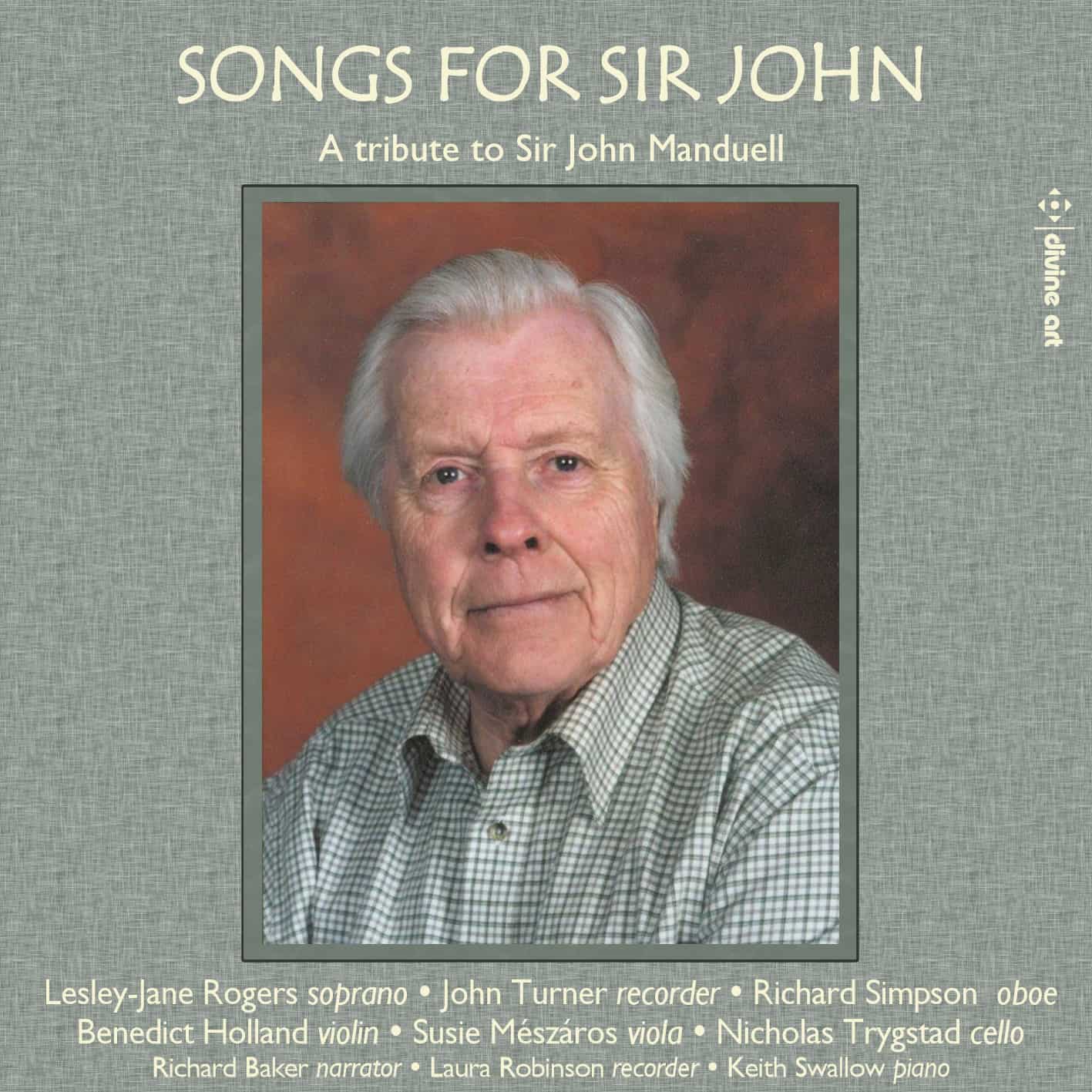
    Songs for Sir John – A tribute to Sir John Manduell

    Sir John Manduell was a pivotal figure in British music – as composer, teacher, BBC producer, first principal of the Northern Royal College of Music and founder of the European Opera Centre. Beloved and revered by musicians, yet someone whose name is shamefully little known outside the music profession.

    This album in tribute presents works by 16 composers from more than one generation, centred around settings of W.B. Yeats and principally songs with oboe, recorder, violin and cello. The music is varied, rich and wonderfully set to the texts, and yet the textures are always transparent and clear; there is nothing inherently ‘difficult’ for the listener. The performers are among the cream of the Music world of Northern England, and also, in the Robin Walker Nursery Rhymes (the only work not specially recorded for the album), feature the iconic veteran BBC presenter Richard Baker. Many of these artists have starred in several other Divine Art and Metier albums – click their names above for details.

    Even without the Manduell connection this is a wonderfully constructed program of new chamber music. In the track list below, the non-vocal works are marked *.

  • Robin Stevens: String Quartets and String Quintet

    Robin Stevens: String Quartets and String Quintet

    The British composer Robin Stevens is a great talent waiting to be discovered by the global music community. His varied, stimulating and expressive work arises from many influences – from the music of the Romantic era, to mathematics, his faith, and the influence of his main teacher in undergraduate days, John Joubert, and he is now producing substantial works for varied instrumental groupings, which are modernist and original, but yet immediately accessible.

    This album contains the premiere recording of the String Quintet, an early work from his student days, rich in allusions to early 20th century works, but already containing many of the elements of his later work: tangy harmonies, intricate counterpoint, modal lyricism and often almost neo-Romantic expression. Above all the works are a reflection of the composer and his perceptions of the word and the people around him, yet at the same time universal in their appeal.

    The two quartets are very different. The first was written in 2008 after the composer had recovered from a 17-year debilitating illness and while his style was developing considerably as he undertook his Doctorate. Its single movement is rich in variety, using a small few thematic ideas in constantly evolving forms. The second, from 2011, is a study of three character types (not necessarily real individuals) which are each distinctive but clearly related.

  • Robin Stevens: Prevailing Winds

    Robin Stevens: Prevailing Winds

    The British composer Robin Stevens is a great talent waiting to be discovered by the global music community. His varied, stimulating and expressive work is exemplified by this collection of music for wind instruments, ranging from the jolly and accessible (yet very difficult to play) Concert Rondo to the darker, deeper and meaningful Grief’s Portrait.

    Stevens has a brilliant touch, and also is an excellent pianist, cellist and guitarist and plays all three instruments here, alongside some of the foremost instrumentalists from the musical hotspot of Manchester, England: John Bradbury (principal clarinet, BBC Philharmonic); John Turner (recorderist: Academy of Ancient Music etc.); Richard Simpson (principal oboe, BBC Symphony), Janet Simpson (former principal keyboardist, Hallé Orchestra); and wonderful soloists Sarah Miller (flutes); Helen Peller (bassoon) and Lindsey Stoker (horn).