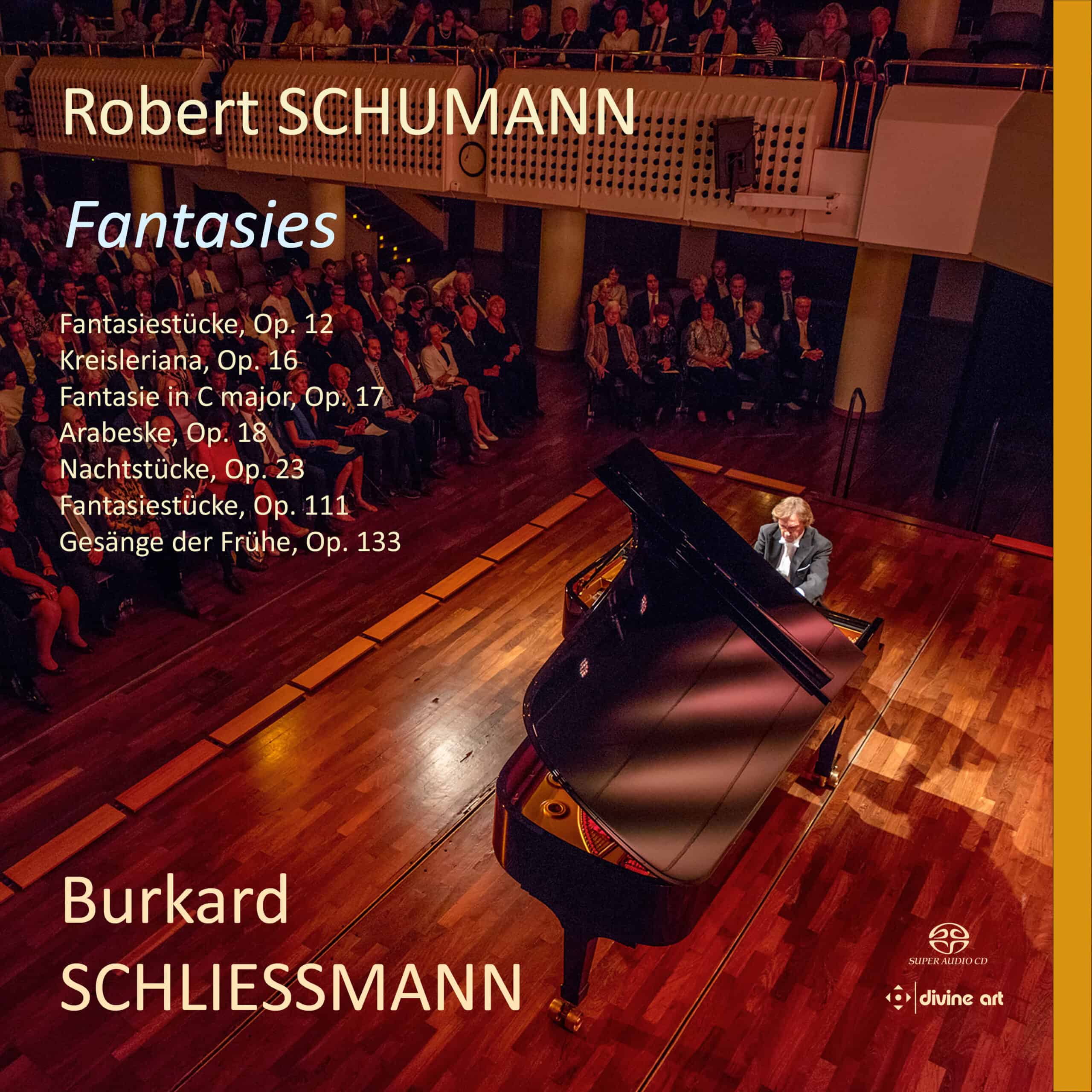
From a musicological standpoint, engaging with this Divine Art box set—three SACDs devoted to Robert Schumann’s piano oeuvre as interpreted by the German pianist Burkard Schliessmann—immediately foregrounds a central hermeneutic premise that the artist himself articulates with notable acuity: that the decisive key to Schumann’s aesthetic world does not lie exclusively in his piano works, but rather in the Lied, where literature and music enter into a uniquely symbiotic relationship. It is within this nexus—where poetic imagination, psychological interiority, and musical structure converge—that Schumann’s compositional thought reveals its full dialectical tension between poetry, illusion, and reality.
The first disc assembles Kreisleriana, Op. 16, the Fantasy in C major, Op. 17, and the Arabeske, Op. 18—works that exemplify Schumann’s early engagement with the fragmentary, the visionary, and the psychologically charged. The second disc juxtaposes the Fantasiestücke, Op. 12, with a second reading of the Arabeske, Op. 18, and Des Abends, the opening piece of Op. 12, thereby illuminating Schumann’s evolving treatment of poetic miniatures and their internal narrative logic. The third disc turns toward the later works: the Nachtstücke, Op. 23, the Three Fantasy Pieces, Op. 111, and the Gesänge der Frühe, Op. 133—compositions that bear witness to Schumann’s increasingly introspective, at times metaphysically inflected, late style.
Taken together, these recordings trace a comprehensive arc—effectively the alpha and omega of Schumann’s pianistic production—offering a unified analytical lens through which the progressive unfolding of his creative trajectory for the piano may be understood. What emerges is a portrait of a composer whose pianistic imagination is inseparable from his literary sensibility, and whose structural innovations are deeply rooted in an intellectual and poetic worldview.
Schliessmann’s interpretive approach underscores precisely this interdependence. His readings illuminate the clarity, rigor, and psychological depth of Schumann’s musical thought, advancing an interpretive model grounded in the fertile dialogue between literature and music that lies at the core of Schumann’s Romantic aesthetics. In doing so, he situates these works not merely as pianistic milestones, but as manifestations of a broader artistic philosophy—one in which musical form becomes a vehicle for poetic consciousness.